What needed to be solved
Provide clear and timely feedback while walking without making the essential safety functions depend on an internet connection or a phone.
How the project addressed it
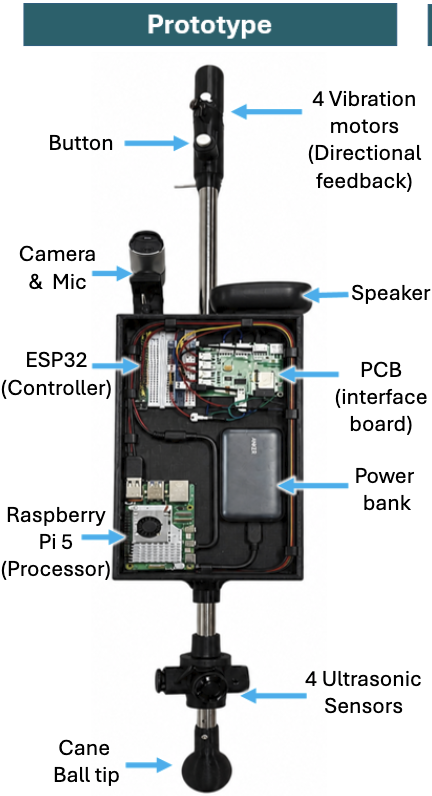
The Raspberry Pi 5 manages voice, audio, camera, and BLE functions. An ESP32 manages five ultrasonic sensors and the vibration motors, keeping the main sensing and alert loop local.
01Ultrasonic sensors
02ESP32
03Raspberry Pi 5
04Voice and BLE
05Haptic alert
My contribution
Contributed to the software design, offline voice interaction, BLE prototyping, Pi–ESP32 integration, and system testing with the electrical and mechanical teams.
- Offline voice-command pipeline using Vosk, voice activity detection, and local text-to-speech.
- Local obstacle detection and haptic feedback continue to operate if BLE is disconnected.
- Integrated software, electrical, and mechanical components into one working prototype.
What the work demonstrated
The prototype demonstrated offline voice commands, immediate obstacle alerts, and a working BLE GATT connection between an iPhone and the Raspberry Pi.